The data economy is already here.
It's logic is poorly understood.
Most institutions are trying to understand the data economy using frameworks built for another era.
The Datalism Observatory tracks how digital systems are reorganising work, value, infrastructure, institutions, and power. It brings together emerging evidence, research, data, and technical experiments to identify structural change before it becomes conventional wisdom.
This is a space for sustained attention to the forces shaping the next decade.
The Observatory is a working laboratory. New signals, tools, research, and experimental outputs will appear here as they are developed.
Latest Signals
Early signs of structural change often appear before there is a settled language for describing them.
Here we collect developments across technology, markets, regulation, organisational design, and infrastructure that may indicate where value, power, and dependency are moving. We aim to publish new insights here every month, with fuller details on our Substack.
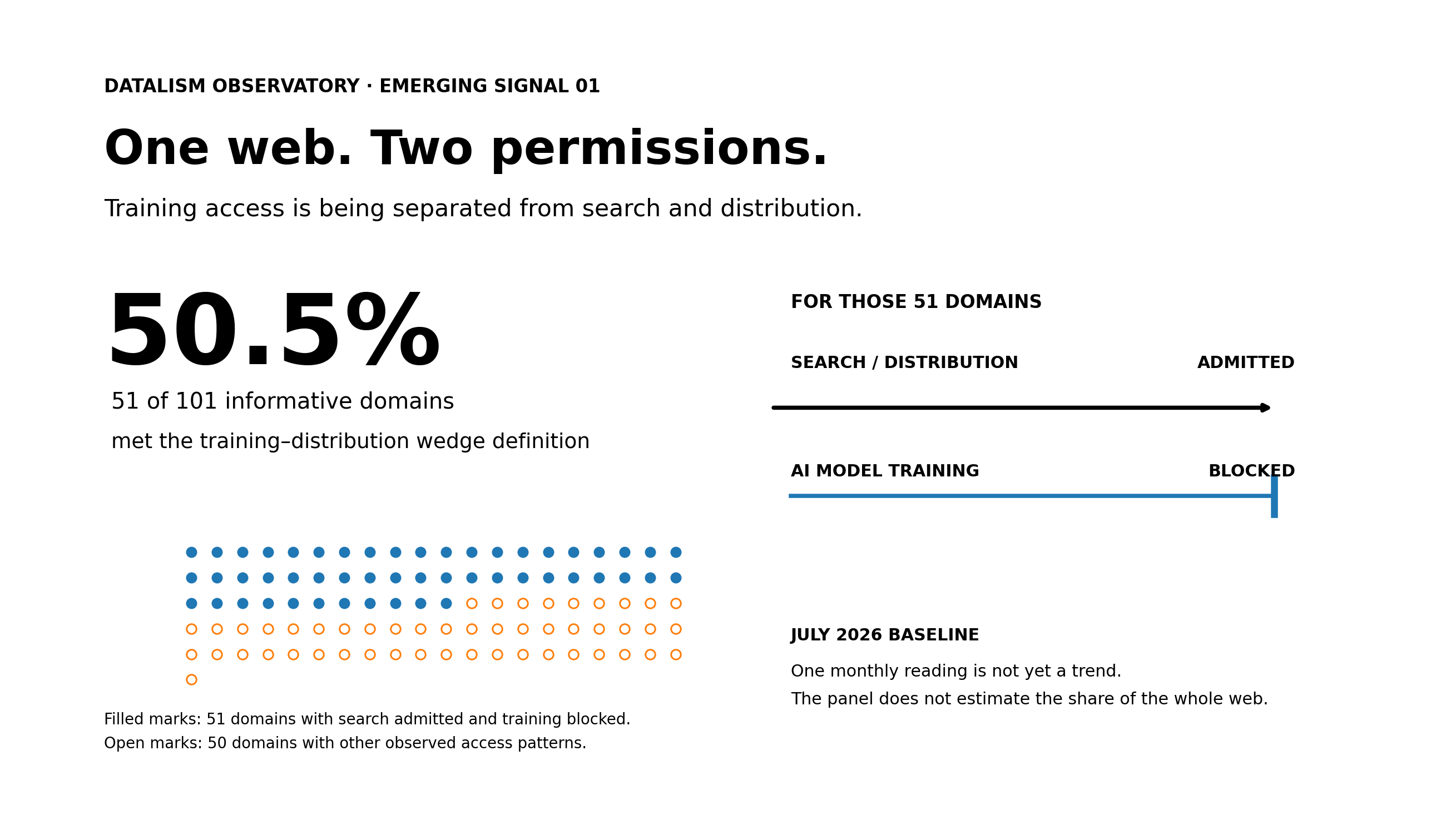
July 2026 baseline. Each mark represents one informative domain. The 51 filled marks show domains that admitted Googlebot while blocking at least one AI training crawler. The remaining 50 domains displayed other access patterns. This is a baseline, not yet a trend.
Is the web developing a price system for machine use - and, if so, who has the power to set the price? 
.svg)